SIPP & SSAS Commercial Property Valuations: What We’re Seeing in the Lancashire Market
One area of commercial valuation work that has been growing noticeably for us at Armitstead Barnett is SIPP and SSAS pension fund valuations.
Over recent years, we have seen increasing numbers of local business owners and investors using pension arrangements to invest in commercial property. In Lancashire in particular, this is a familiar feature of the market, with smaller commercial properties often being acquired by business owners who then occupy the property through their own business.
It creates an interesting dynamic. The purchaser is both an investor and an occupier – effectively a hybrid of the traditional investment and owner-occupier markets.
For valuers, that distinction matters.
Why are SIPP and SSAS property investments popular locally?
For some business owners, purchasing their own premises through a SIPP or SSAS can provide a way of holding commercial property as part of their pension investment while their trading business occupies the building.
We regularly see this with smaller commercial properties such as workshops, industrial units, offices, trade premises and retail properties.
It can be particularly relevant in the Lancashire market, where there is a large base of owner-managed and family businesses and a substantial stock of relatively modest-sized commercial properties.
The business becomes the tenant, paying rent to the pension scheme, while the property itself forms part of the pension investment.
HMRC guidance permits a sponsoring employer or scheme member to rent commercial property owned by the pension scheme, provided the commercial rent due is paid. Transactions involving connected parties also need to be undertaken on an appropriate commercial, arm’s-length basis.
That is one reason independent property valuation can be important.
The interesting part: investor or owner-occupier?
From our perspective, one of the more interesting aspects of this market is what happens when these buyers are looking for property.
A conventional investor is primarily concerned with the investment characteristics – rental income, lease terms, yield, tenant covenant and future capital value.
An owner-occupier has a different set of priorities. They may be much more interested in the location for their particular business, the suitability of the accommodation, access, yard space, expansion potential or the cost of adapting an alternative property.
The small business owner buying through a SIPP or SSAS can effectively be both at the same time.
They are acquiring an investment, but they are also buying the premises from which their business may operate for many years.
That can make these transactions particularly interesting from a valuation perspective. A property may be attractive to one particular occupier for reasons that don’t necessarily translate directly into wider market value.
Understanding the difference between a property’s value as an investment and its usefulness to a particular business is therefore important.
Case Study – Galgate Workshop Valuation
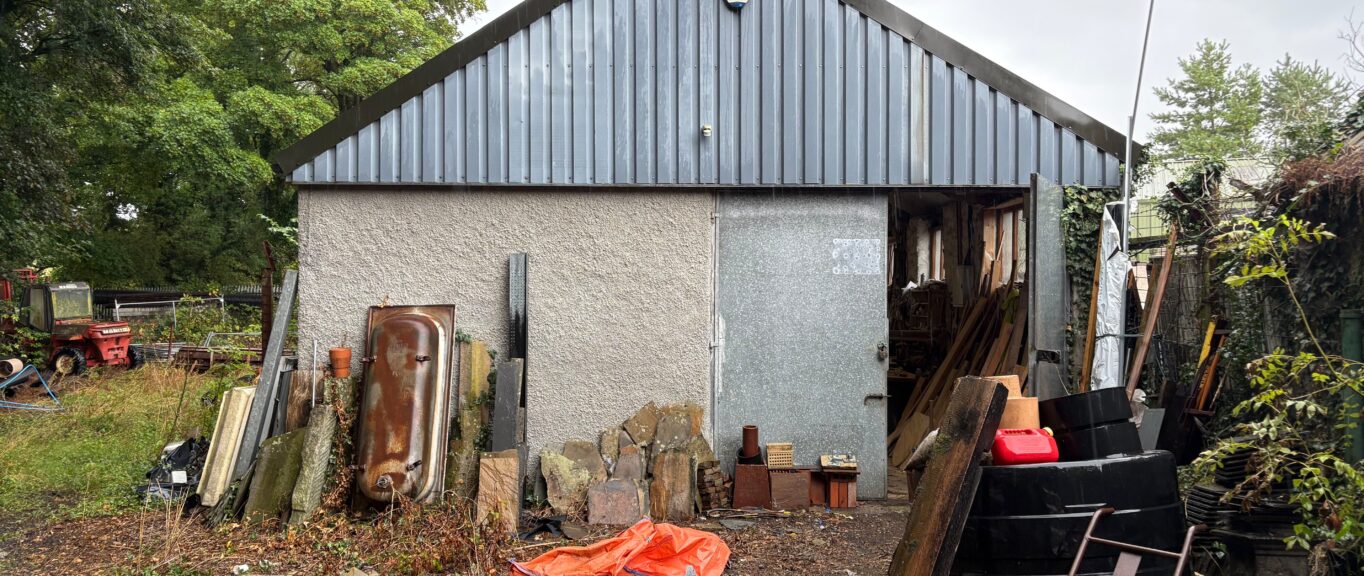
We recently valued a small workshop near Galgate, Lancaster, for a client who was transferring the property out of their SIPP.
It is exactly the sort of property we increasingly encounter in this area – relatively small-scale commercial premises with a very specific local market.
The valuation involved considering the property’s location, accommodation, condition, access and occupational characteristics, alongside available comparable evidence and the wider local commercial market.
Small commercial properties can sometimes be more difficult to value than larger investment properties because there may be relatively few directly comparable transactions.
Local knowledge becomes particularly useful in these circumstances. Understanding what similar workshops, industrial units and trade premises are actually achieving in the surrounding area can be more informative than relying on broad regional averages.
SIPP and SSAS valuations are becoming a bigger part of our work
Pension-related property valuations are now a more established part of our commercial valuation workload.
We undertake valuations for a range of purposes, including properties being transferred into or out of pension schemes, as well as valuations required for ongoing scheme administration and review.
RICS has specific guidance covering regular valuations of real estate held by investment vehicles including pension funds, while RICS-regulated valuers undertaking valuations must follow the relevant valuation standards.
A SIPP or SSAS valuation might involve a £multi-million investment property, but just as often it involves a local workshop, office, shop or industrial unit where the circumstances of the individual property really matter.
Why local knowledge matters
The Lancashire commercial property market is not one single market.
A small workshop around Galgate and Lancaster can have a very different market profile from an industrial unit in Preston, a shop in Garstang or a commercial property in Clitheroe, Blackburn or the Ribble Valley.
Rental values, investor demand, availability of stock and the requirements of local businesses all vary.
Our SIPP and SSAS valuation work takes us across Lancashire and Cumbria, including Lancaster, Garstang, Preston, Clitheroe, Burscough, Lytham, Fylde, Leyland, Chorley, Blackburn, the Ribble Valley and Kendal, as well as surrounding towns and villages.
That local perspective is particularly valuable where there may only be a small number of genuinely comparable transactions.
An area of valuation work we expect to keep seeing
The growth of pension-held commercial property is something we have noticed directly through our own workload rather than simply as a national property trend.
For local business owners, the combination of owning their premises, paying rent through their business and holding the property as part of a pension investment can be an attractive structure where the relevant pension and tax rules are met.
For us as valuers, it means increasingly working at the intersection between the investment market and the owner-occupier market – and that is an interesting place to be.
As SIPP and SSAS property continues to feature in the Lancashire commercial market, we expect pension fund valuations to remain an increasingly important part of our commercial valuation work.
Whether a SIPP or SSAS is appropriate for an individual or business is a matter for a regulated financial or pension adviser. Our role is to provide independent property valuation advice.



Read More Journals









Thank You
Thank you for contacting us, a member of our team will be with you shortly.